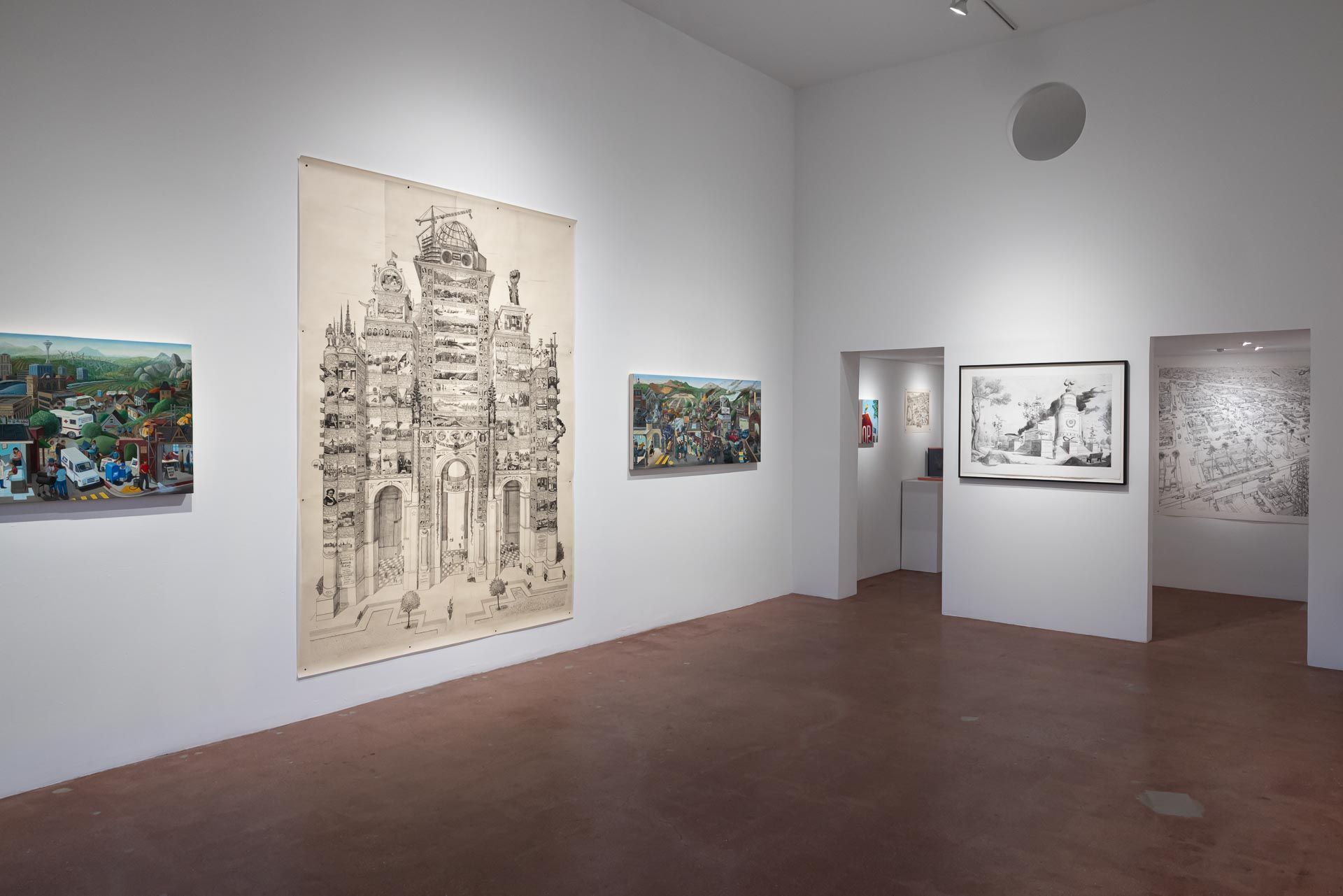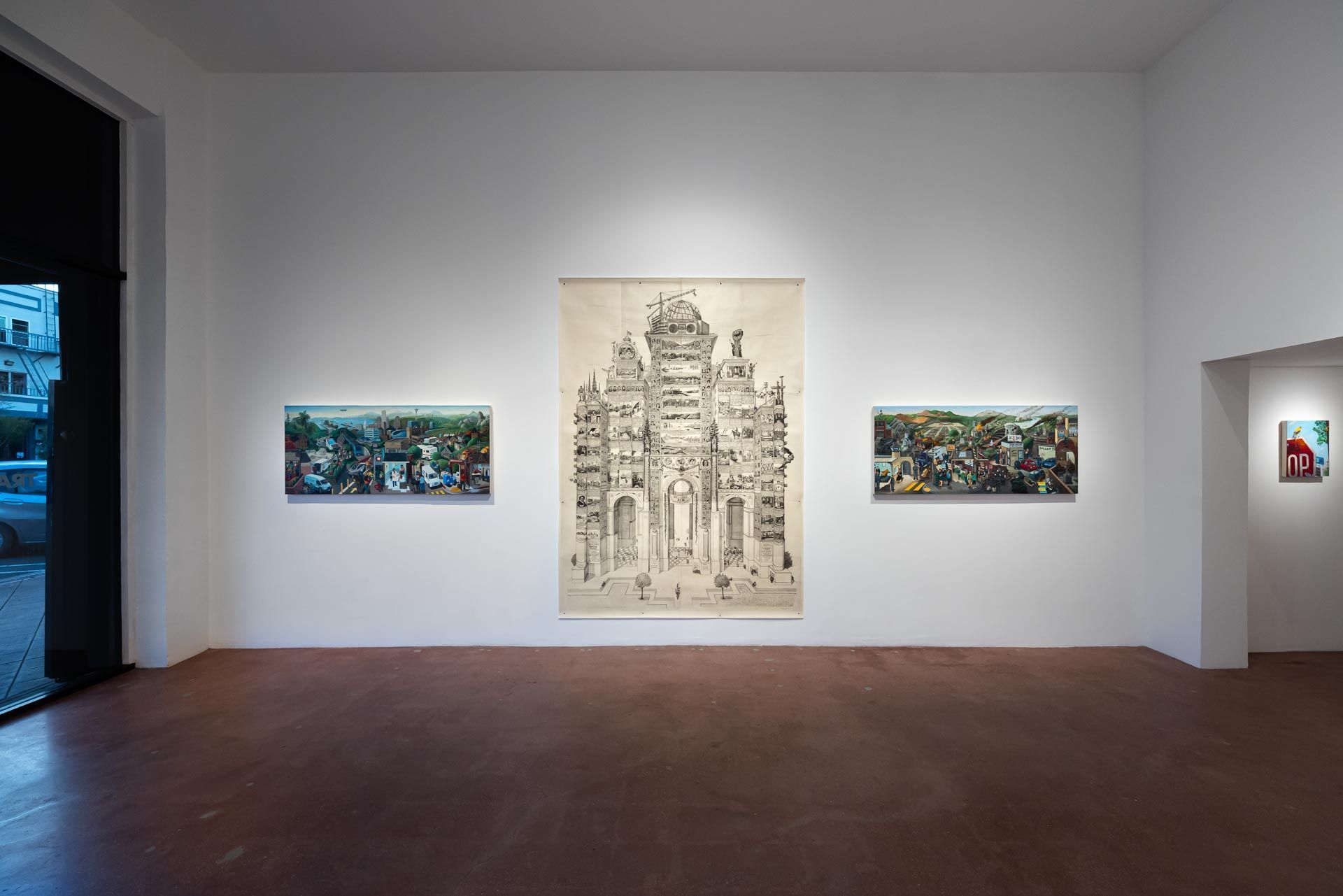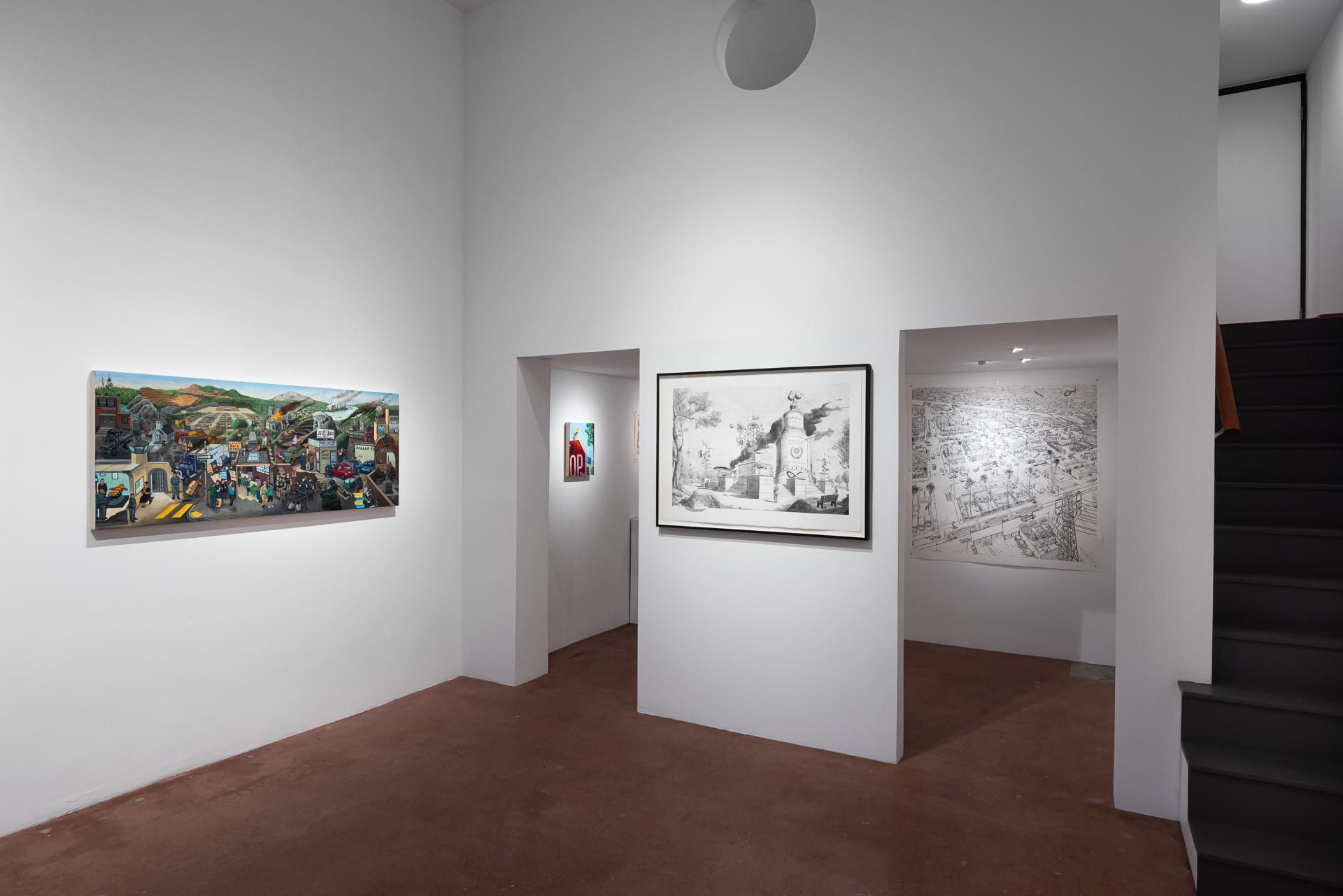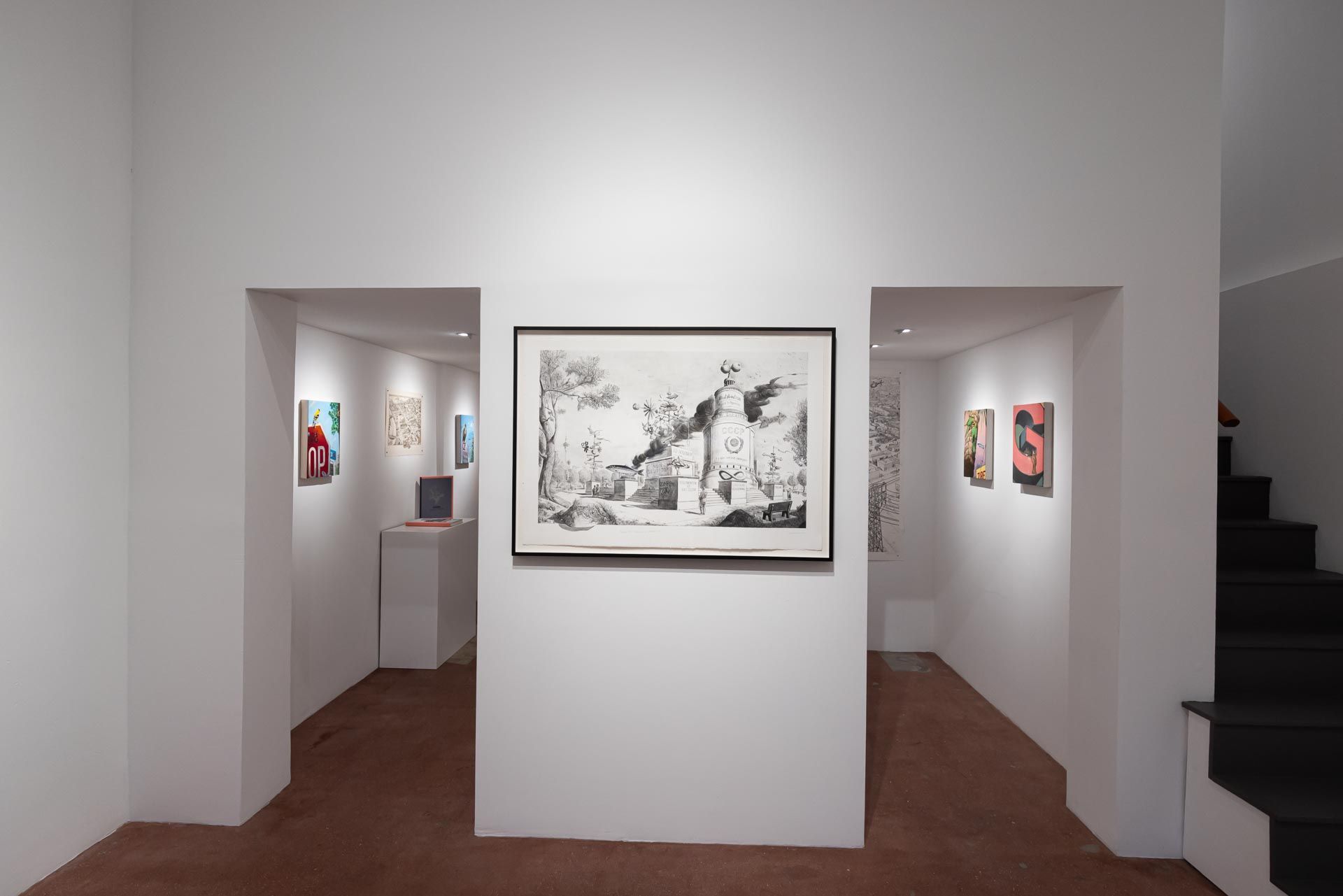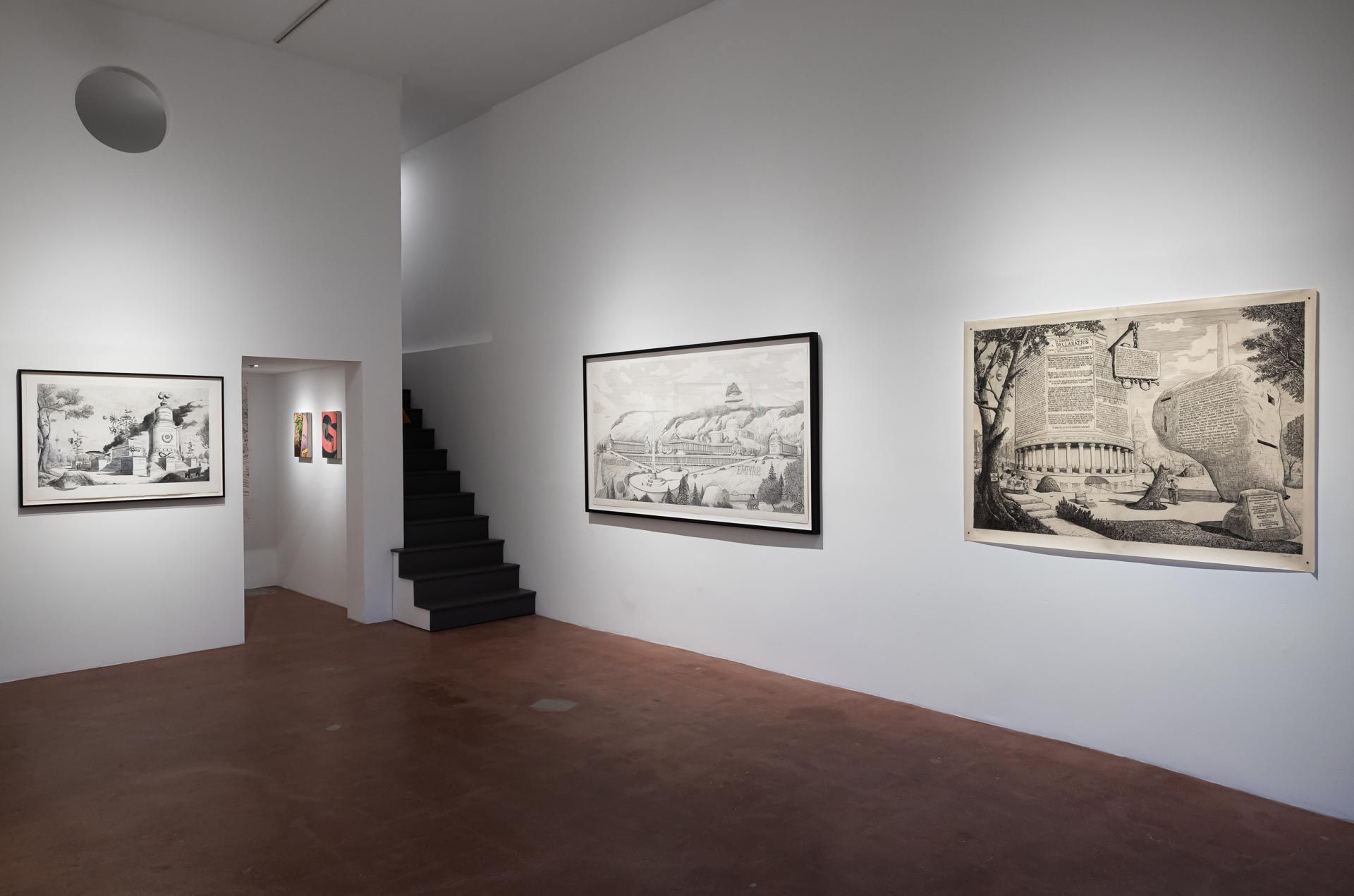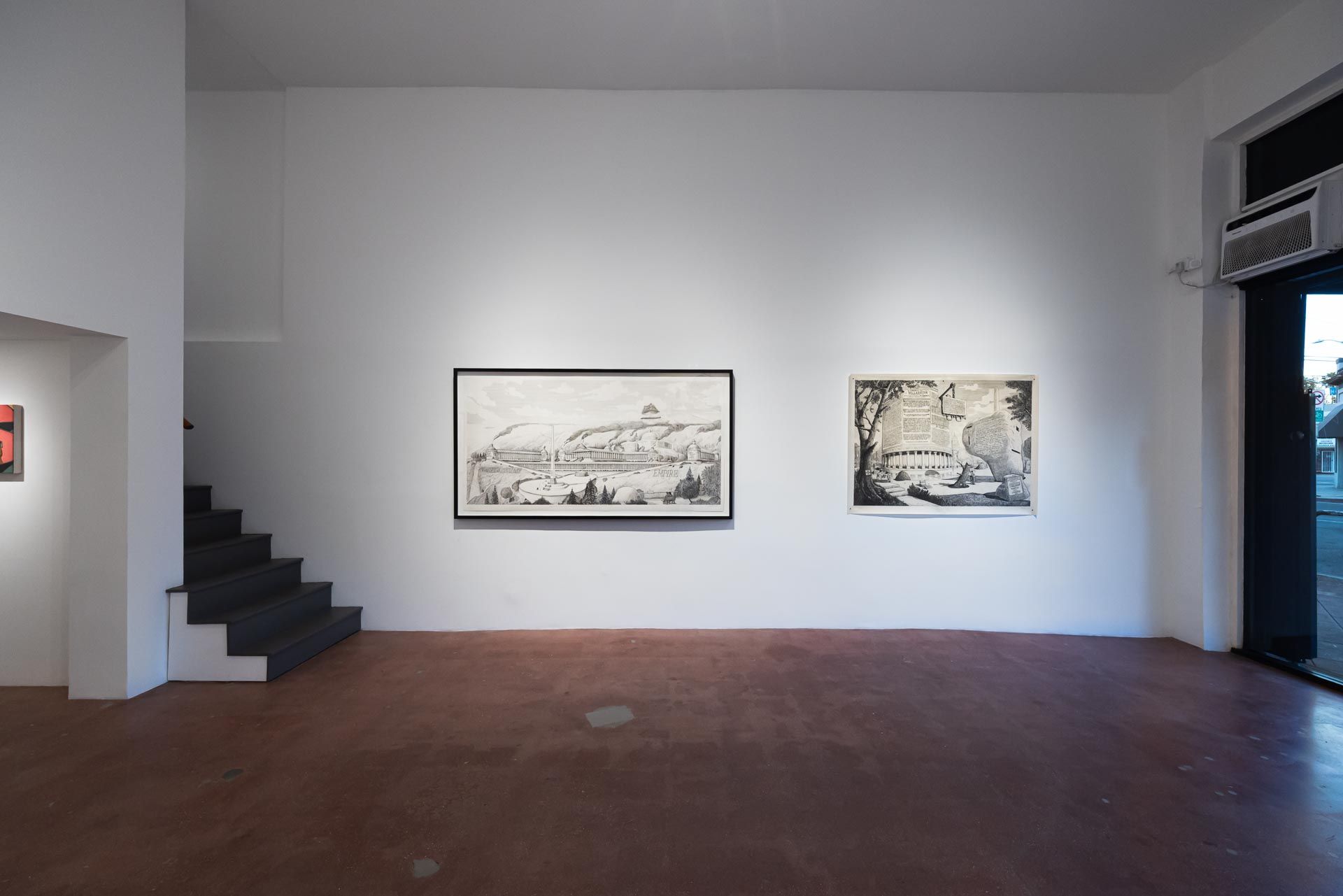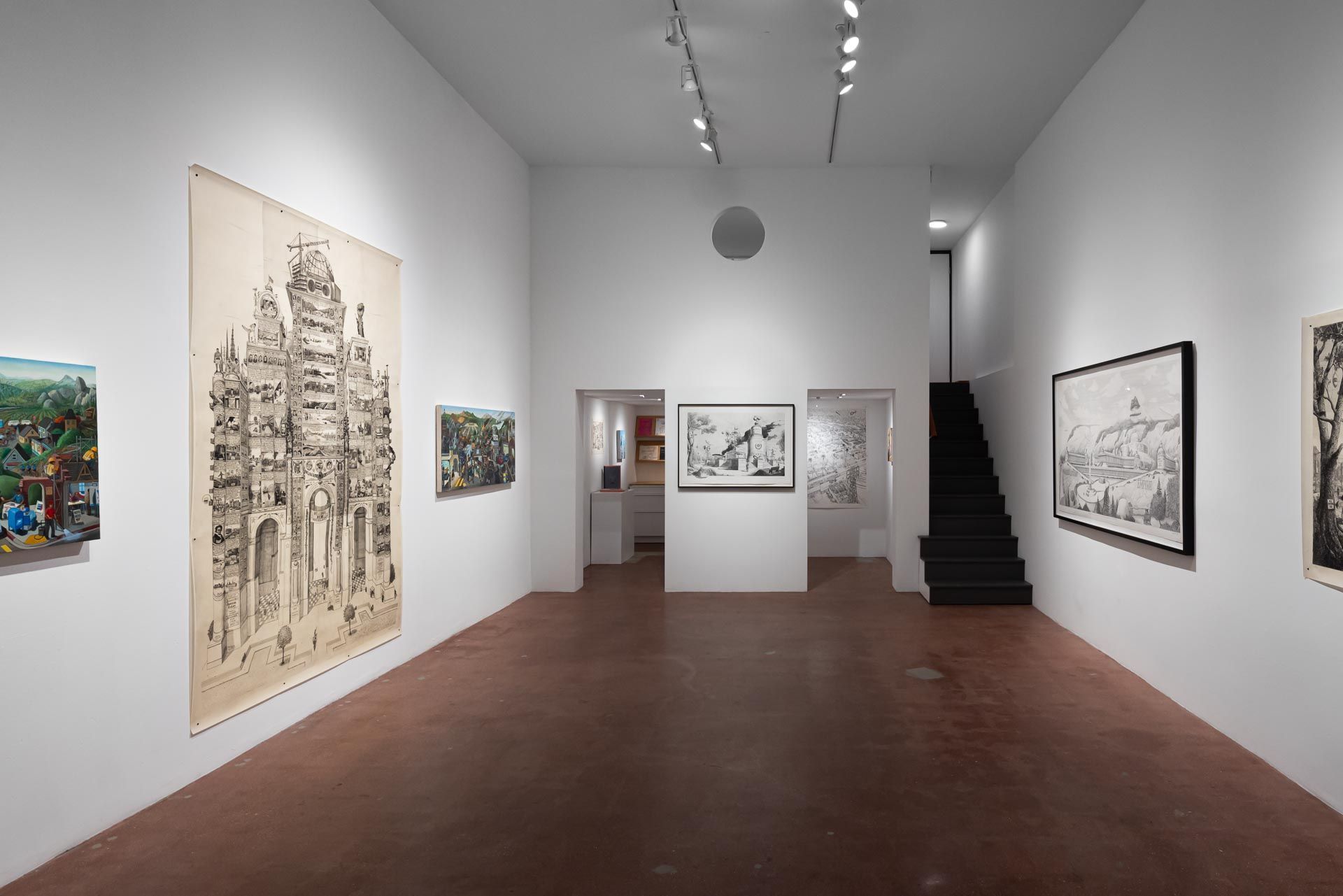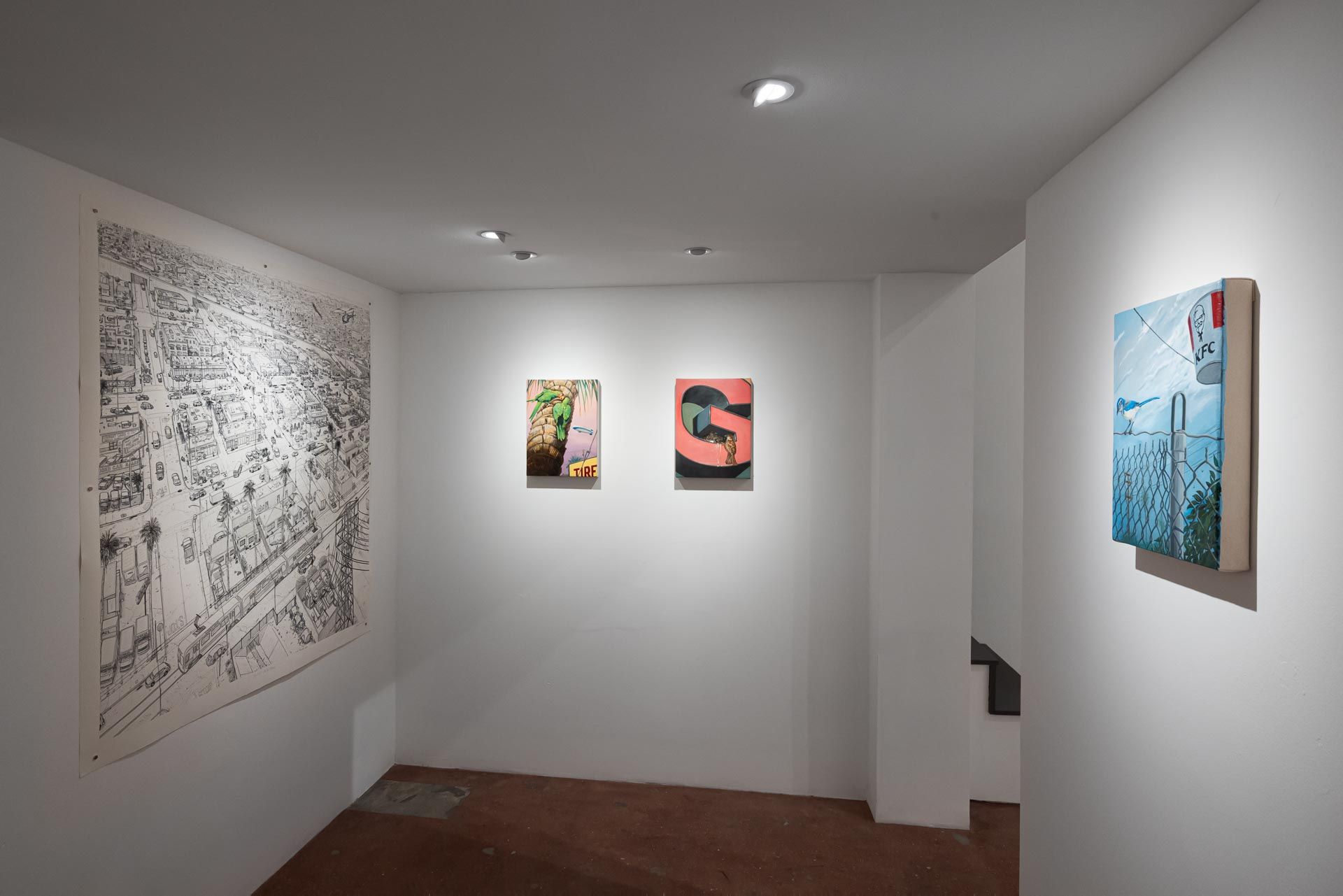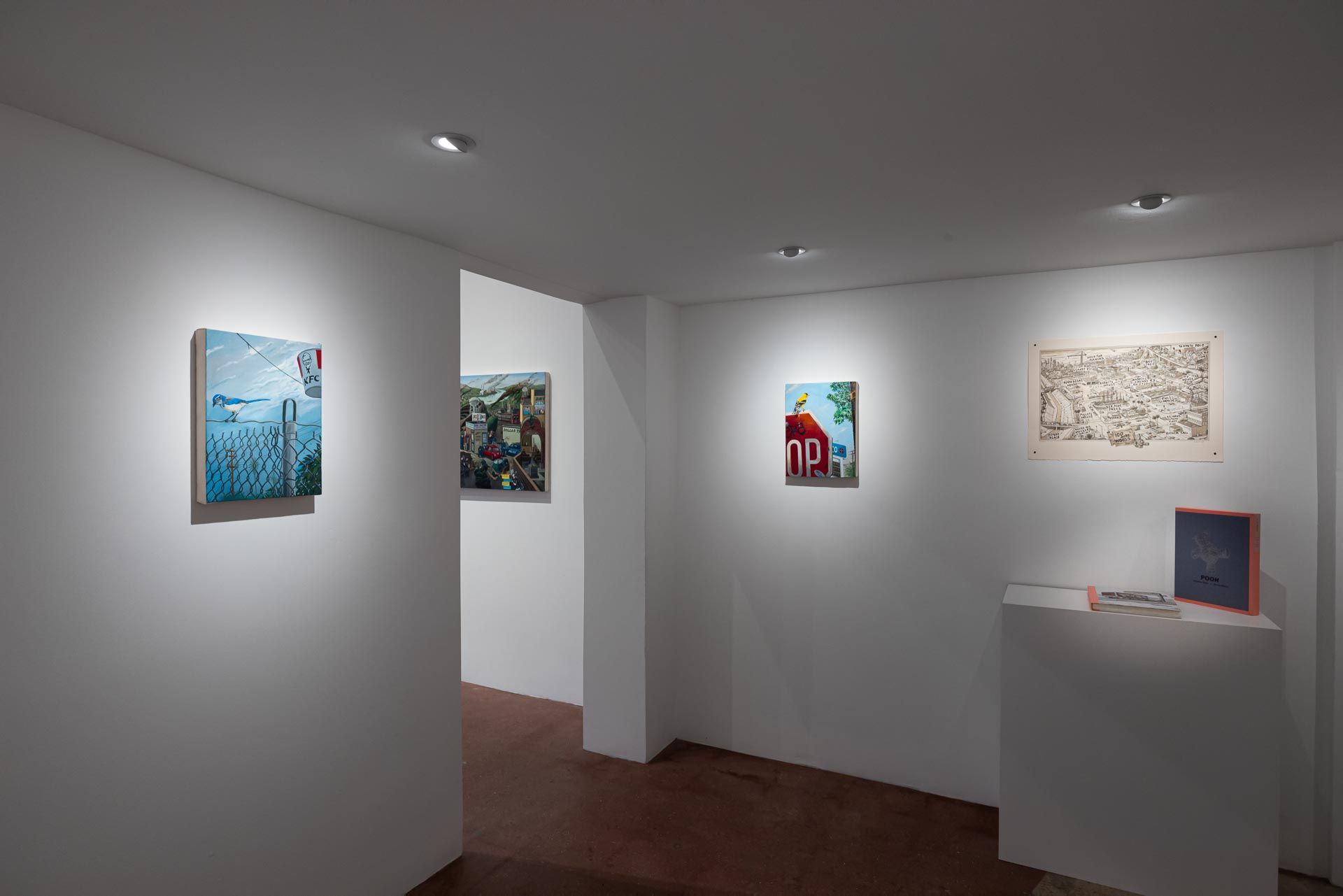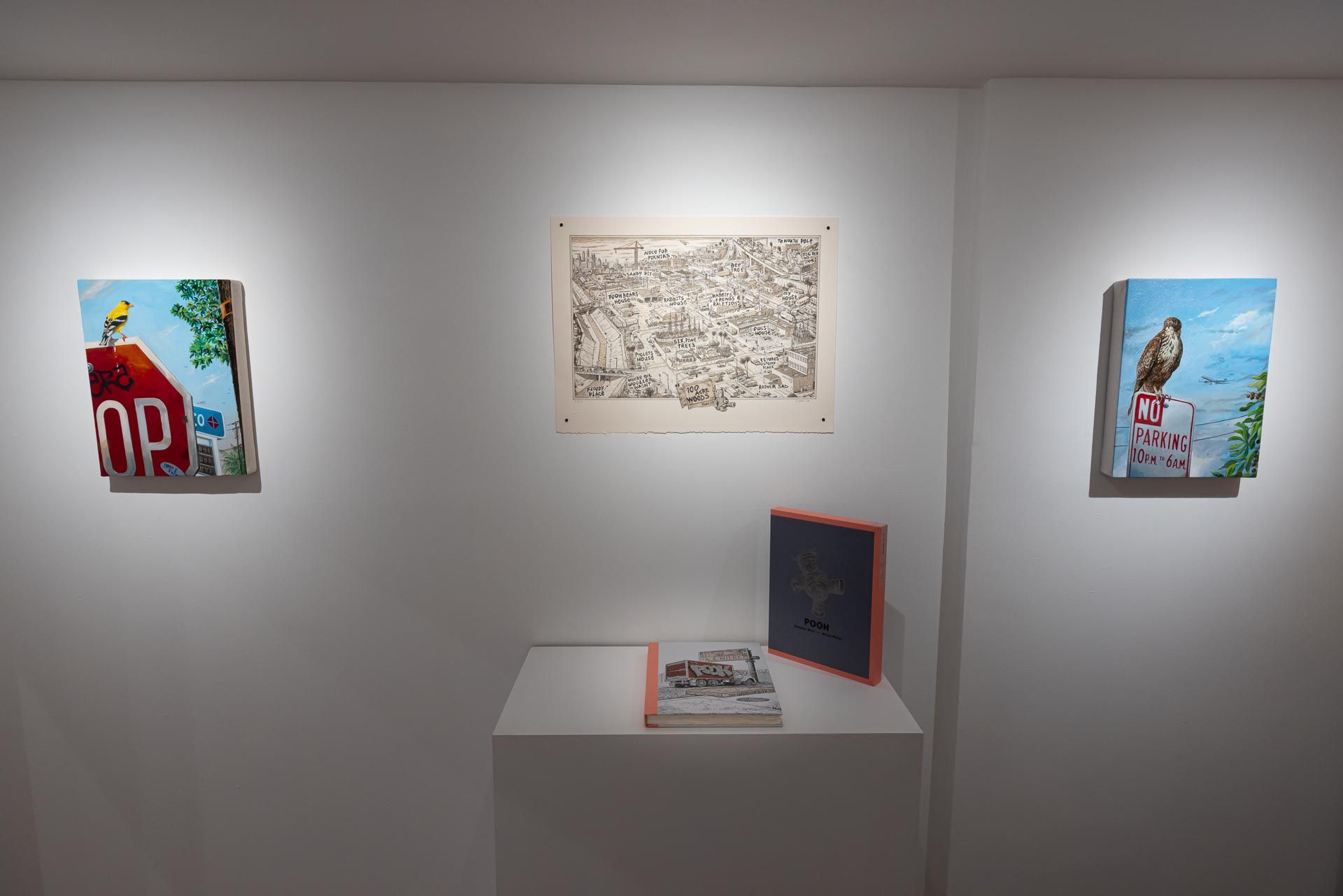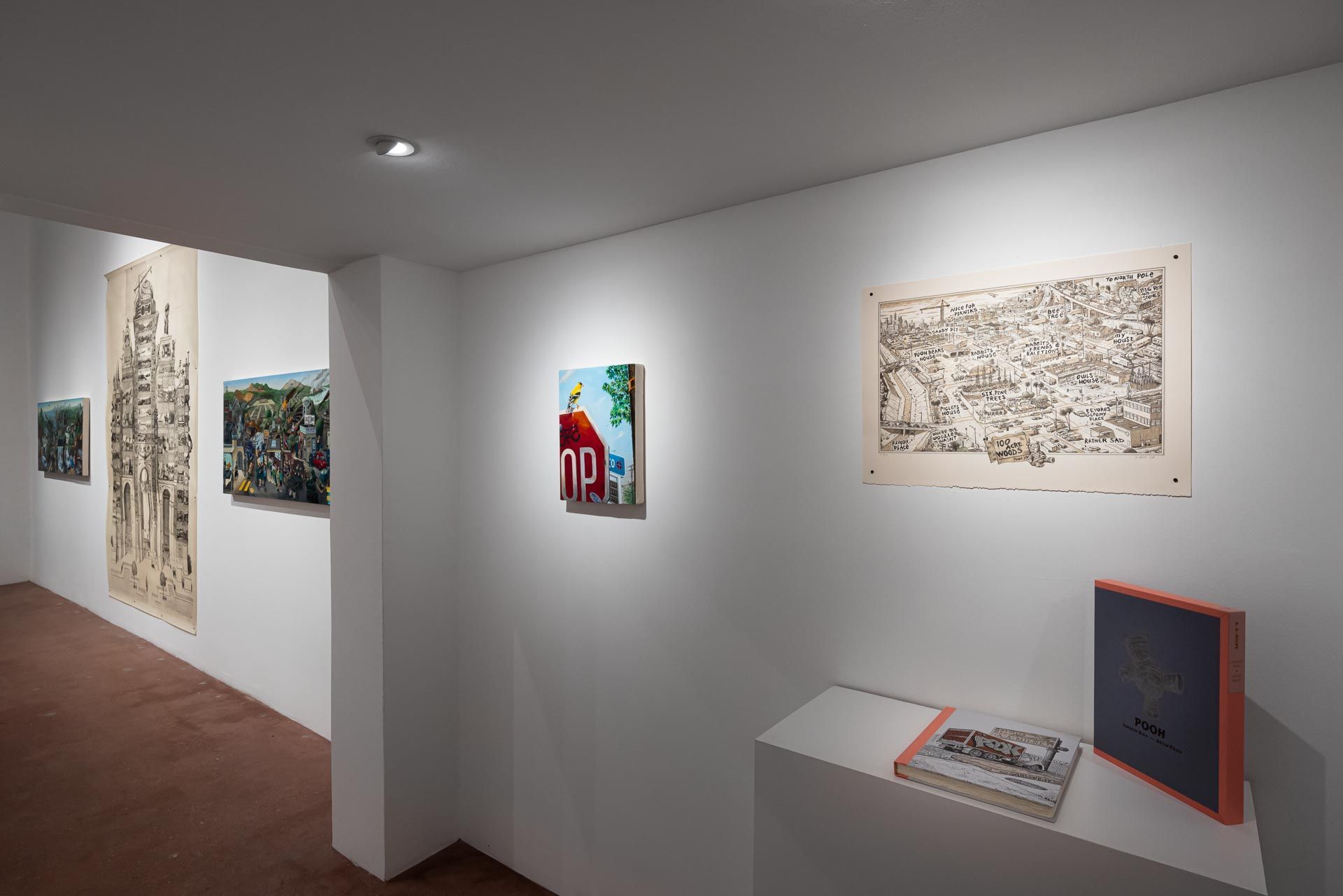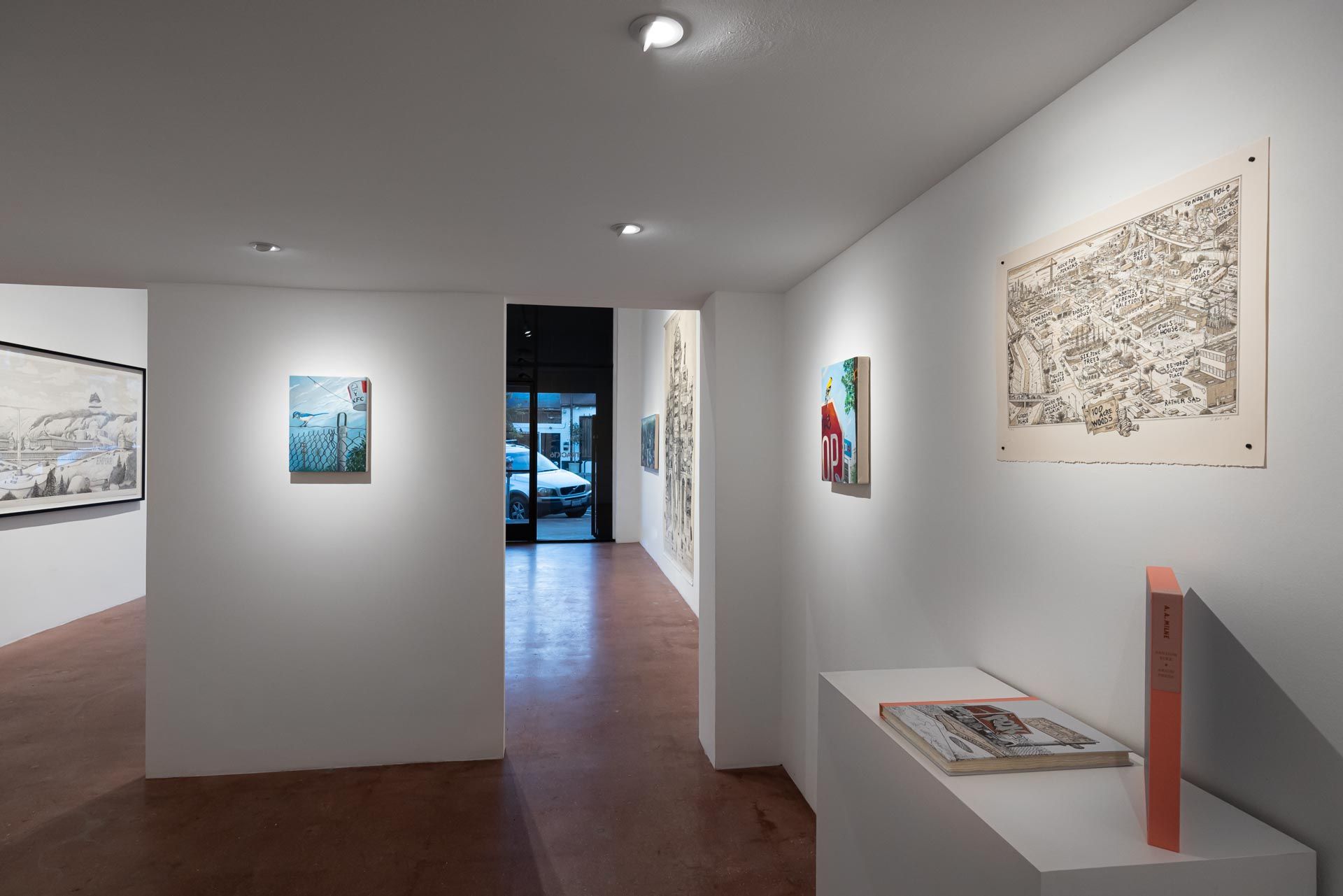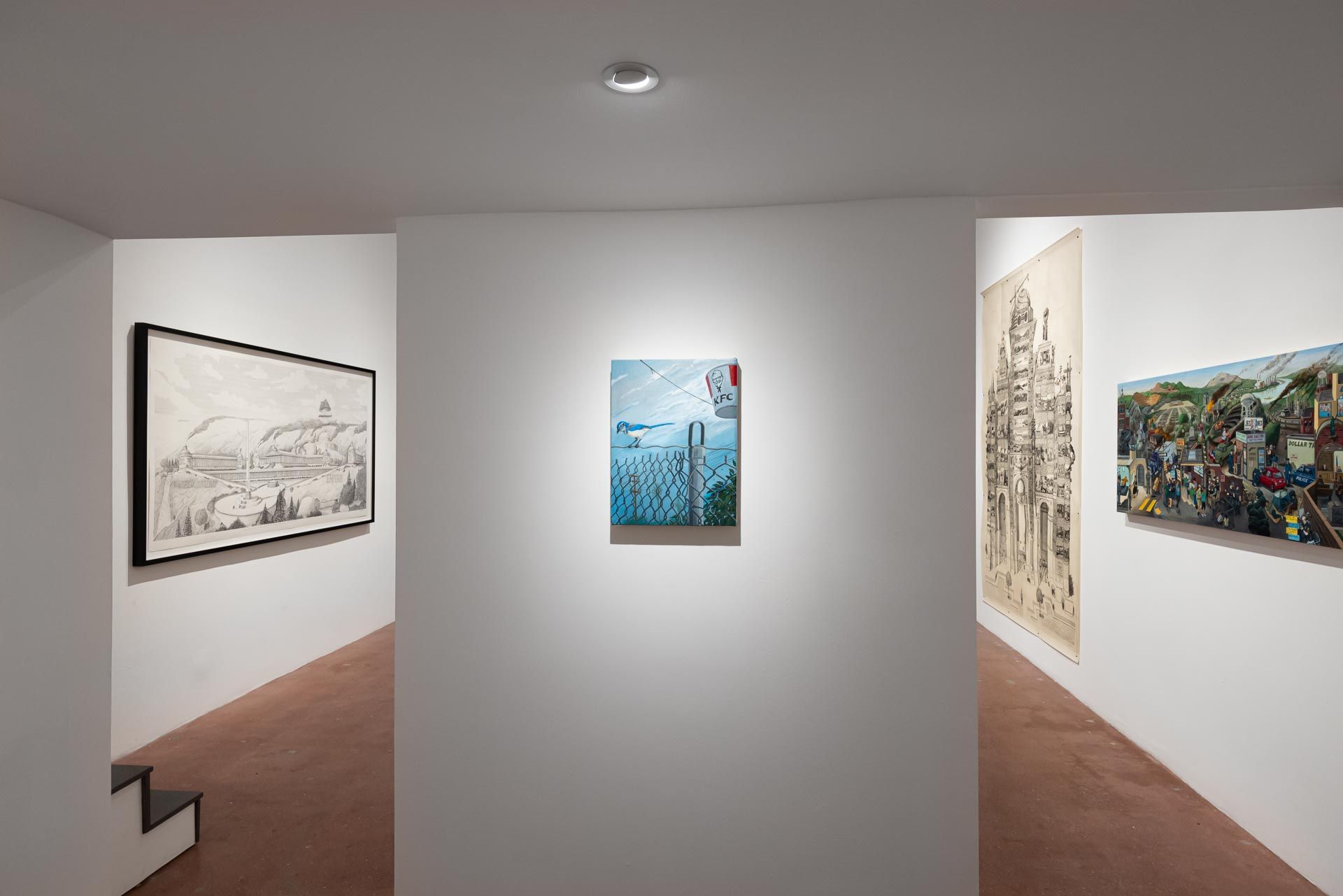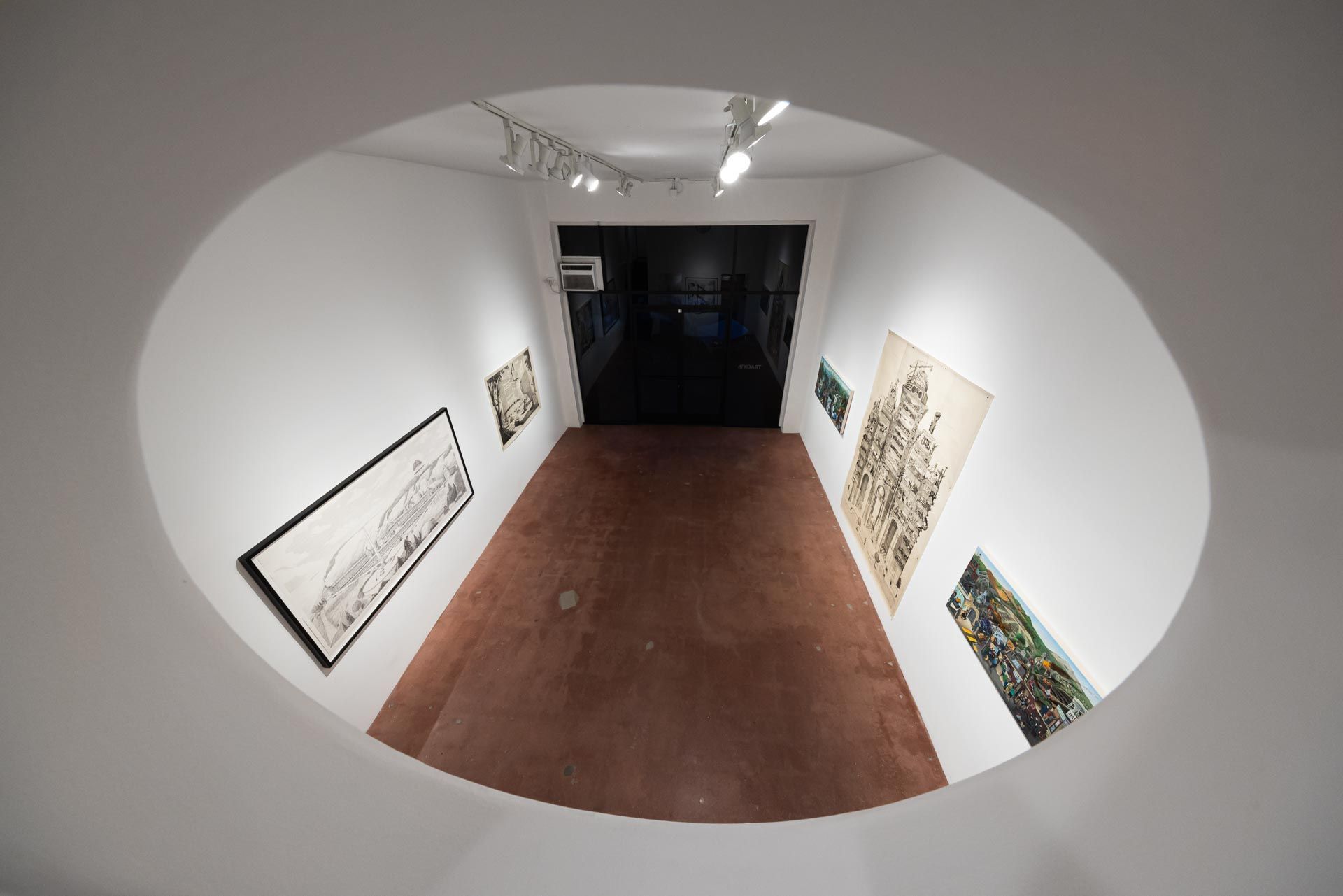
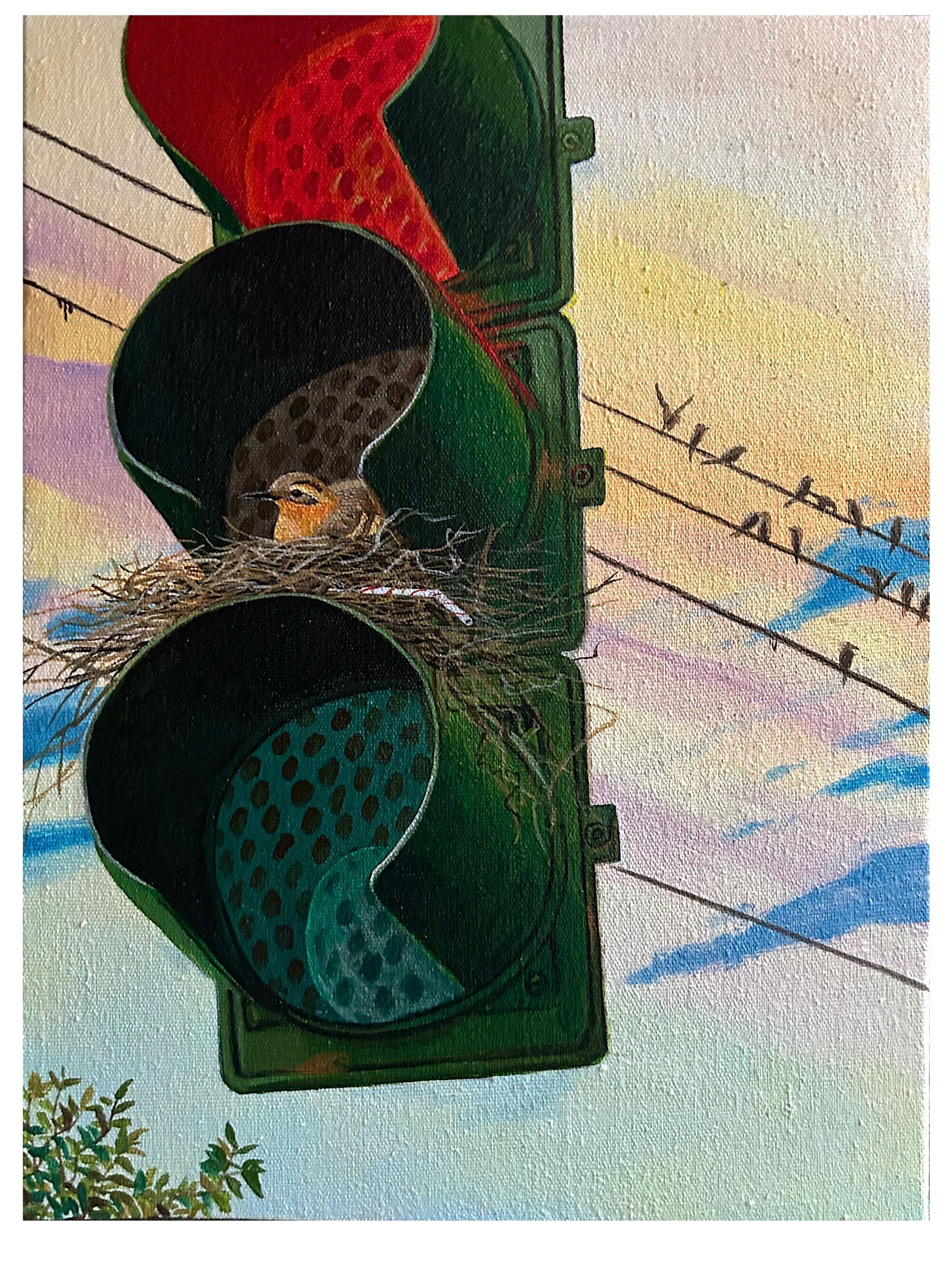
Entering the world of Sandow Birk is to step into a tragic fairy tale—one inverted, where the “kingdom” is not distant but familiar, shaped by the realities of democracy, urbanism, and contemporary life. Presented in interrelated segments at Track 16 in East Hollywood, Snafu unfolds as an allegorical landscape where each body of work is a chapter in a larger civic fable.
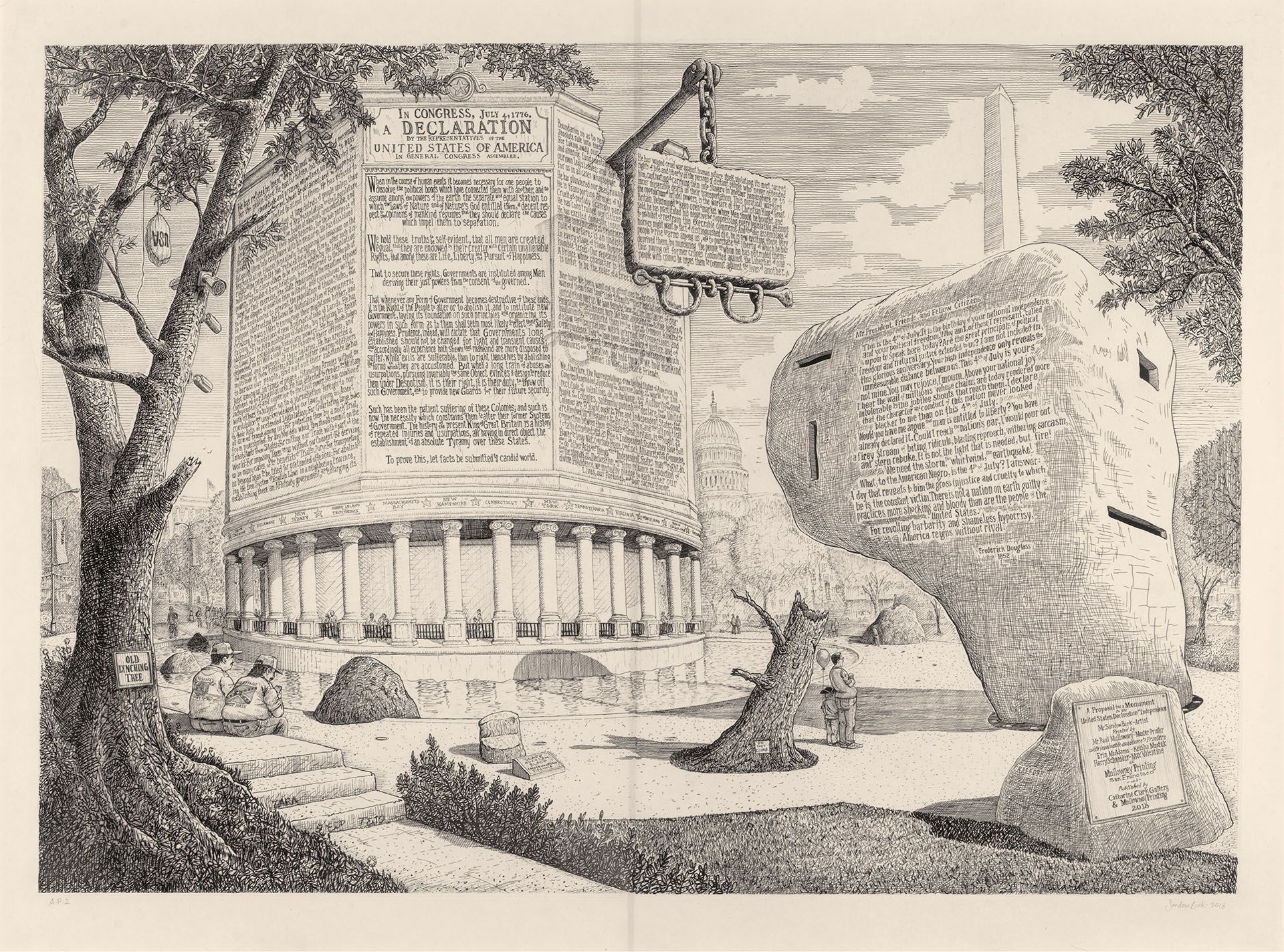
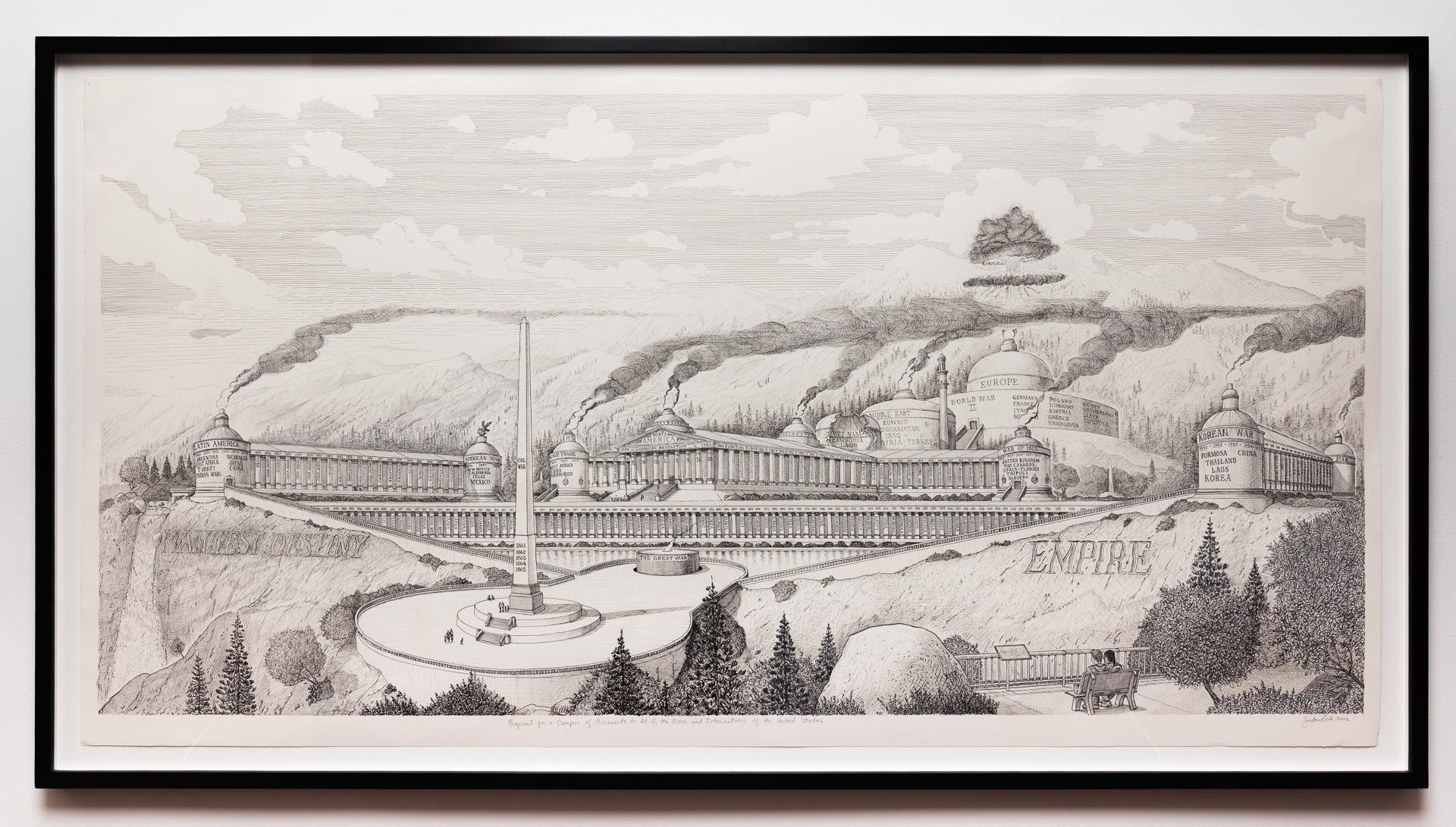
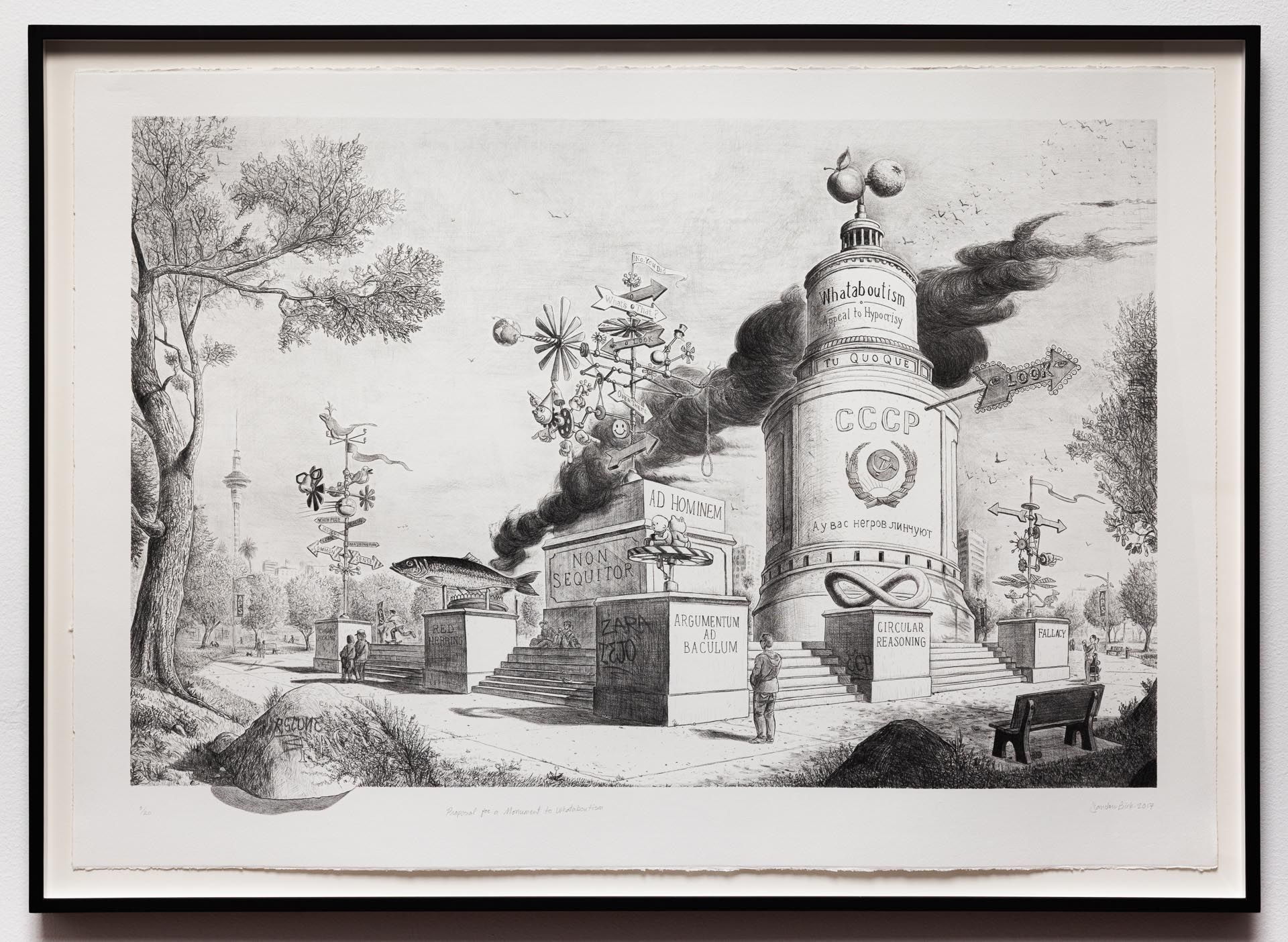
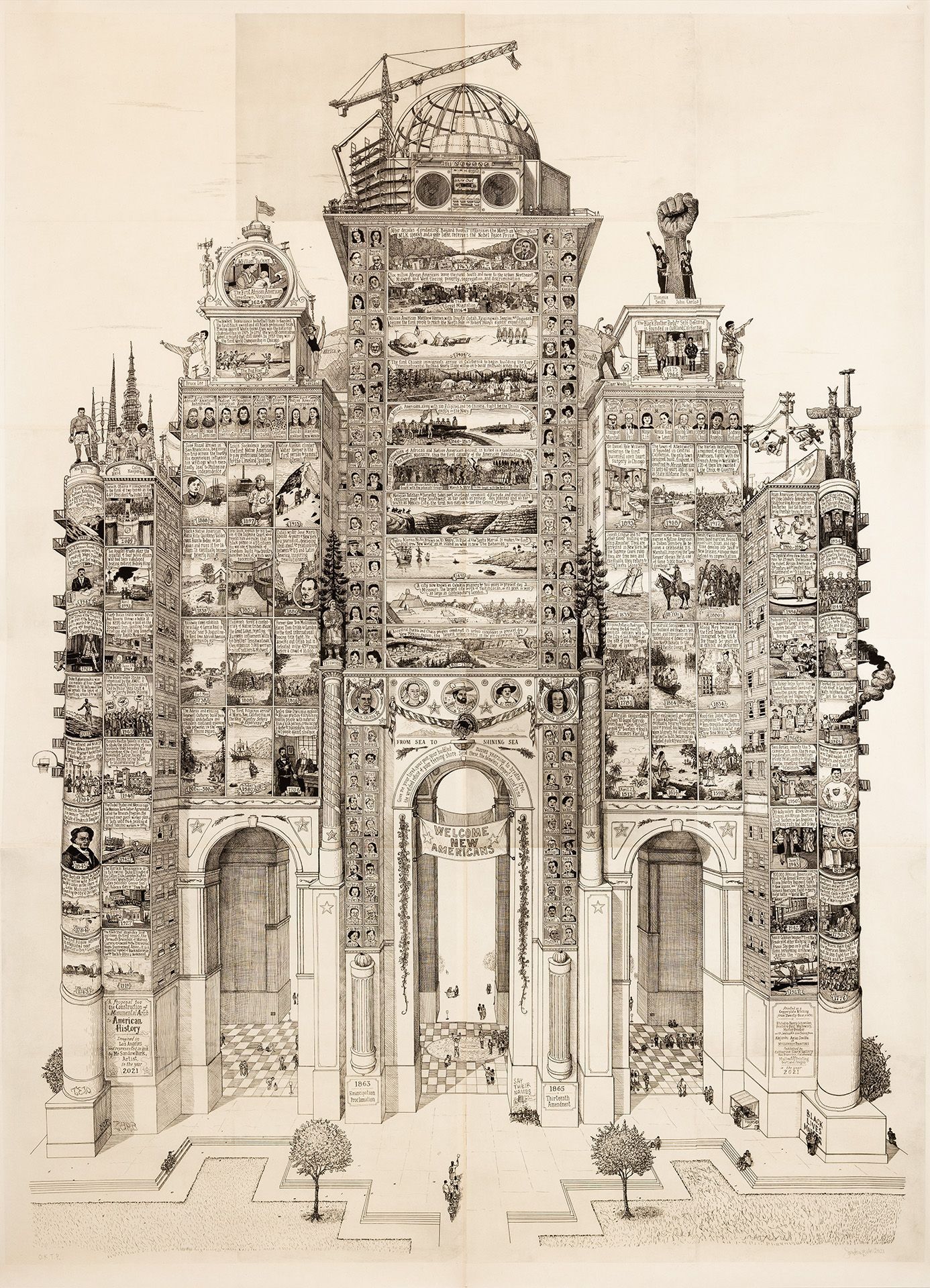
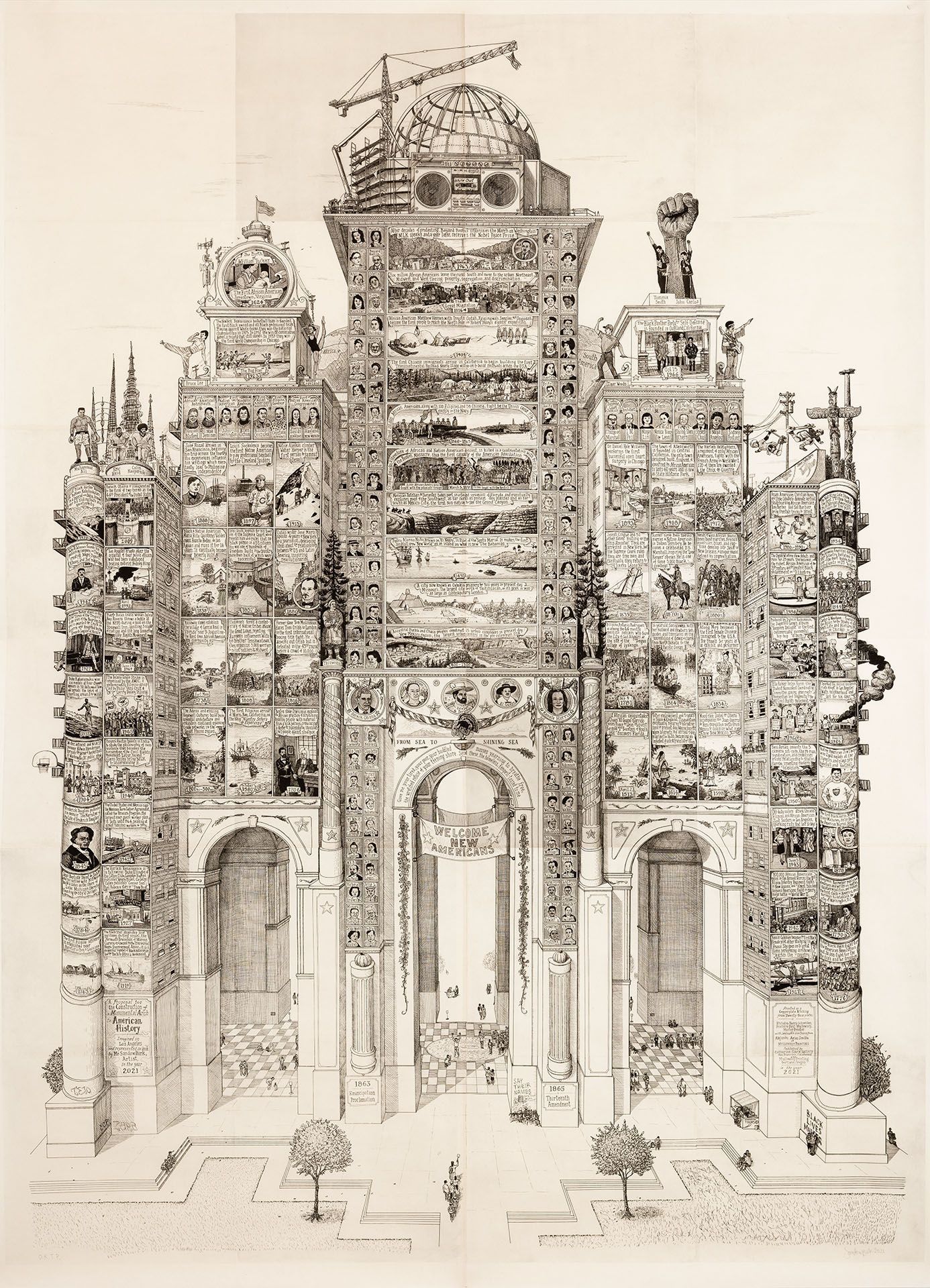
In Imaginary Monuments, speculative architectures rise like ruins from both past and future, recasting the American empire, governance, and historical narrative. Anchoring the exhibition is White Out: A Monumental Arch to American History, an eight-and-a-half-foot-tall etching printed with 24 copper plates. As the arch continues its long history as a component of propaganda (i.e. “Arc de Trump”), Birk employs it to counter entrenched power. Inspired by Albrecht Dürer’s 13-foot-high Triumphal Arch (1515), it stands as a reimagined gateway—one that asks viewers to pass through and reconsider a shared U.S. “foundational” history as something built, formed, and shaped by people of color, long present yet often obscured.
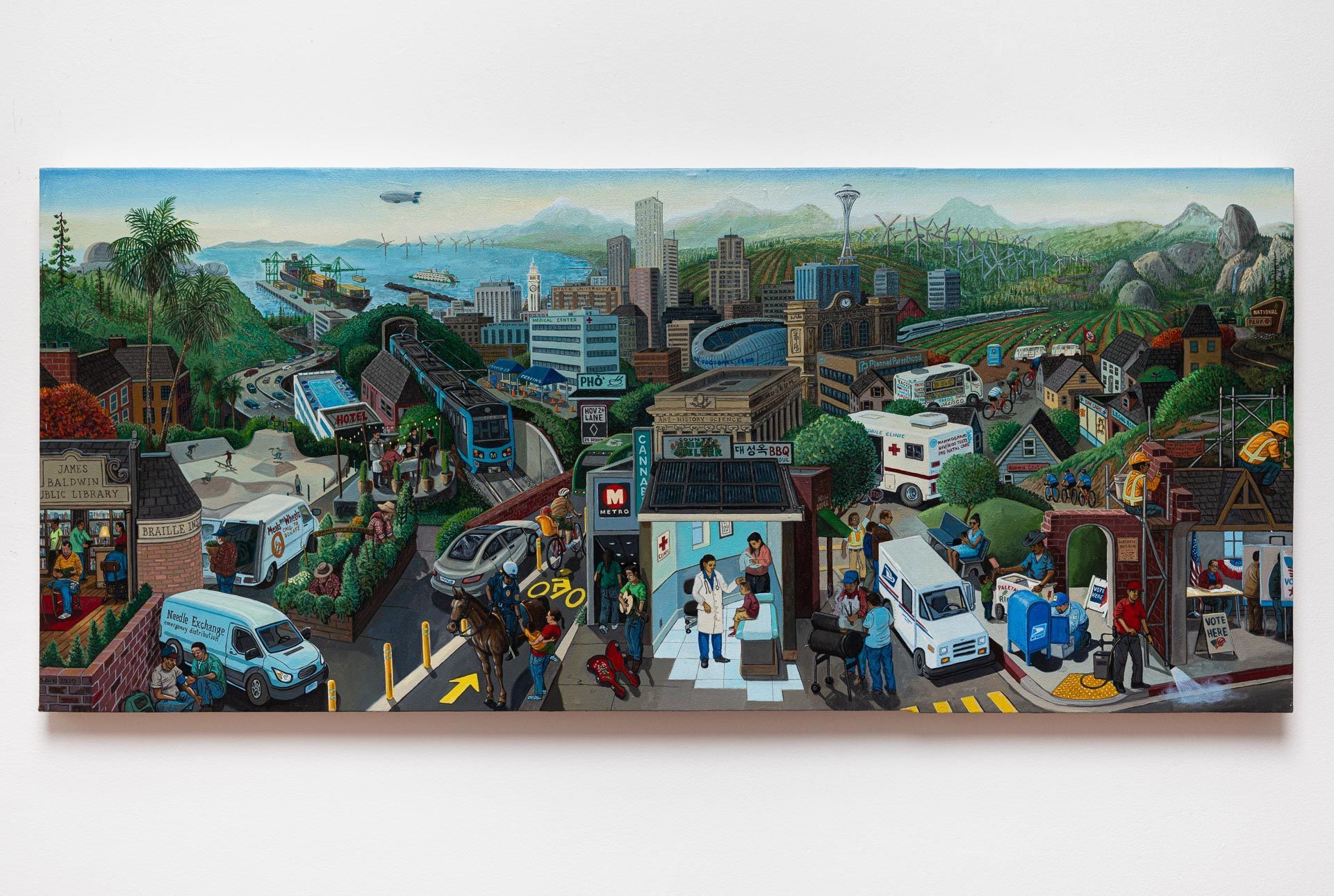
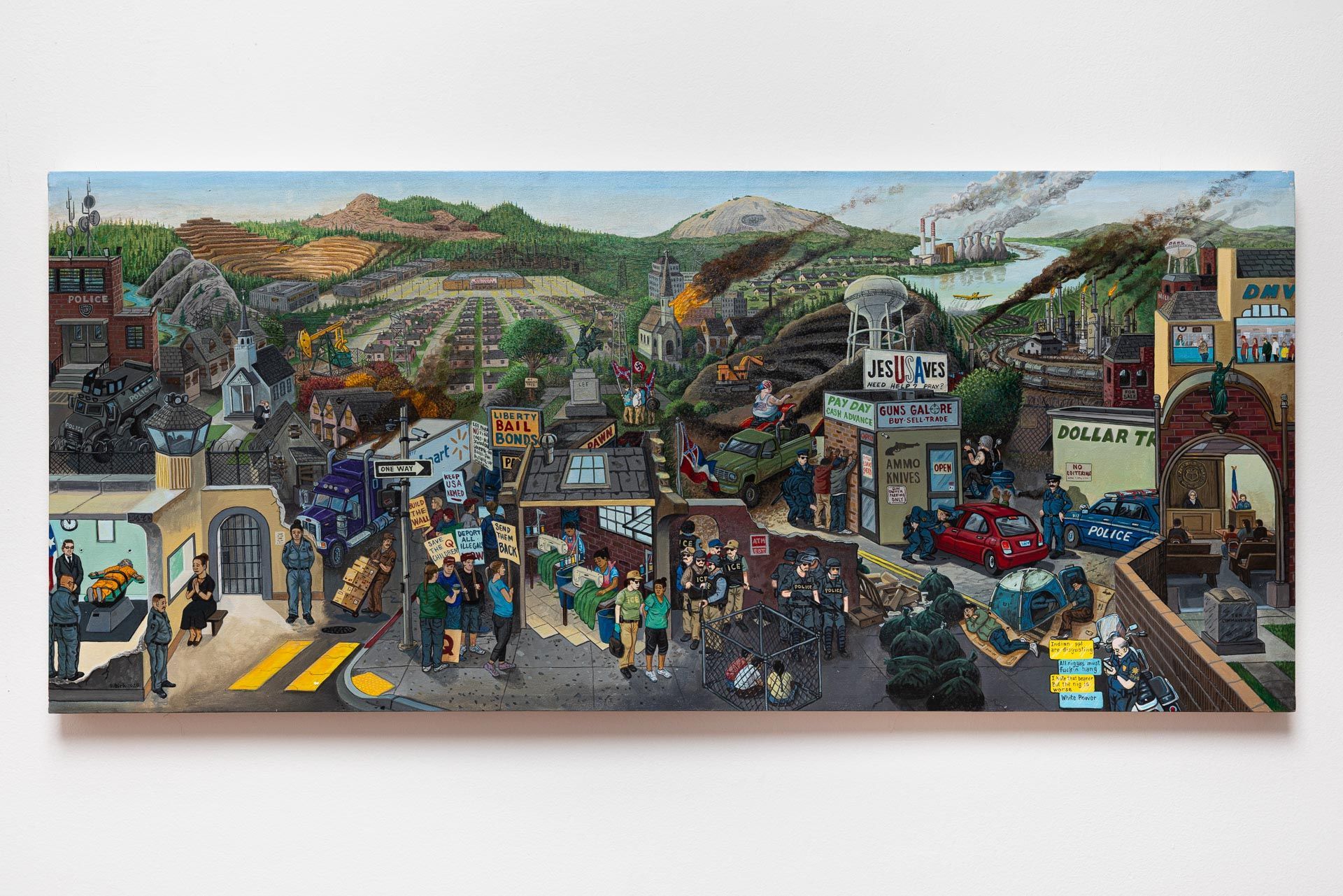
Beyond the monuments, the story splits. Two opposing paintings unfold side by side—one sustained by balance and collective care, the other fractured by neglect and an excess police state. Modeled on Ambrogio Lorenzetti’s trio of 14th-century frescos, The Allegory of Good and Bad Government, they function as a living allegory of governance. Like in today’s America, the viewer is poised between two possibilities and their contemporary ramifications.
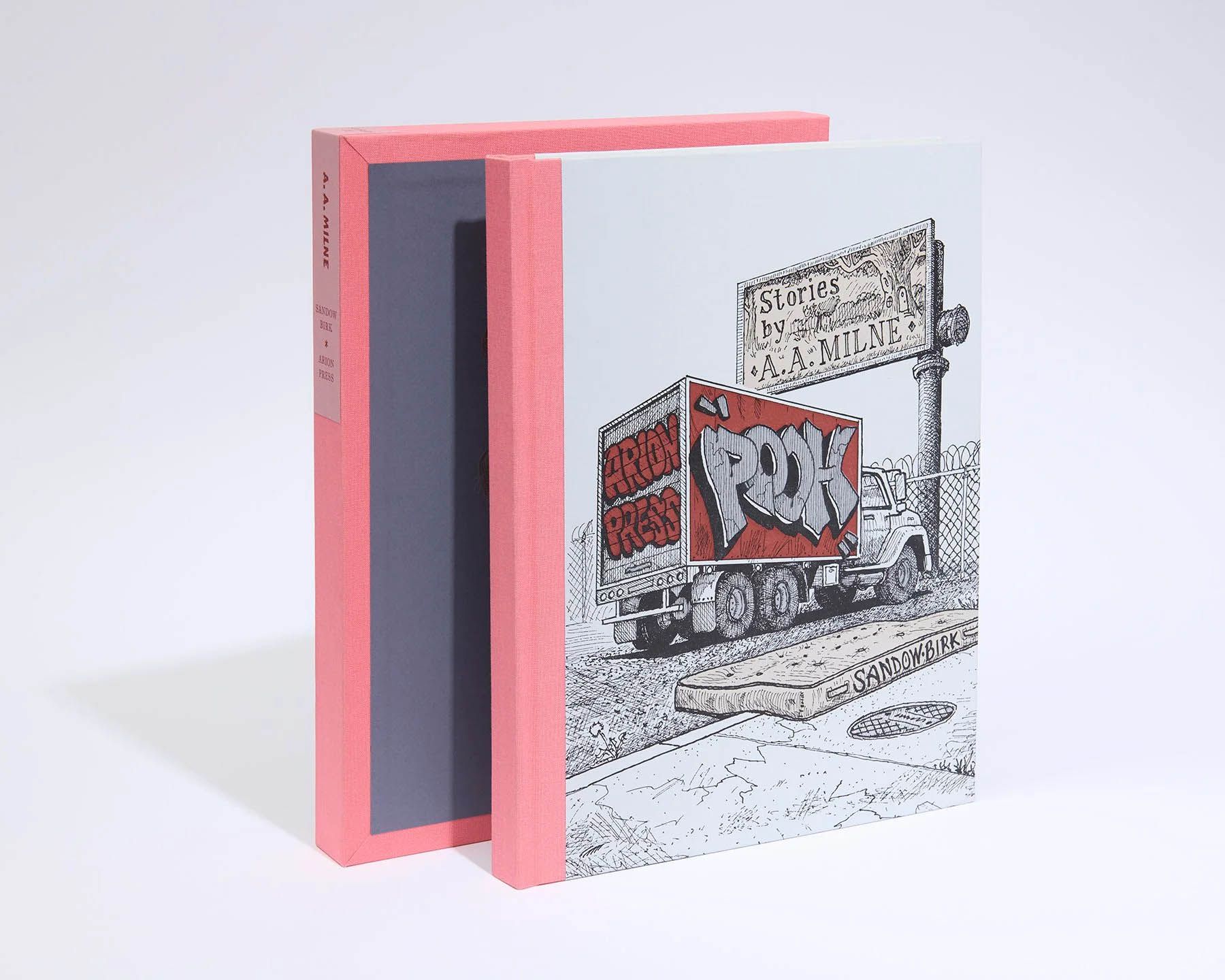
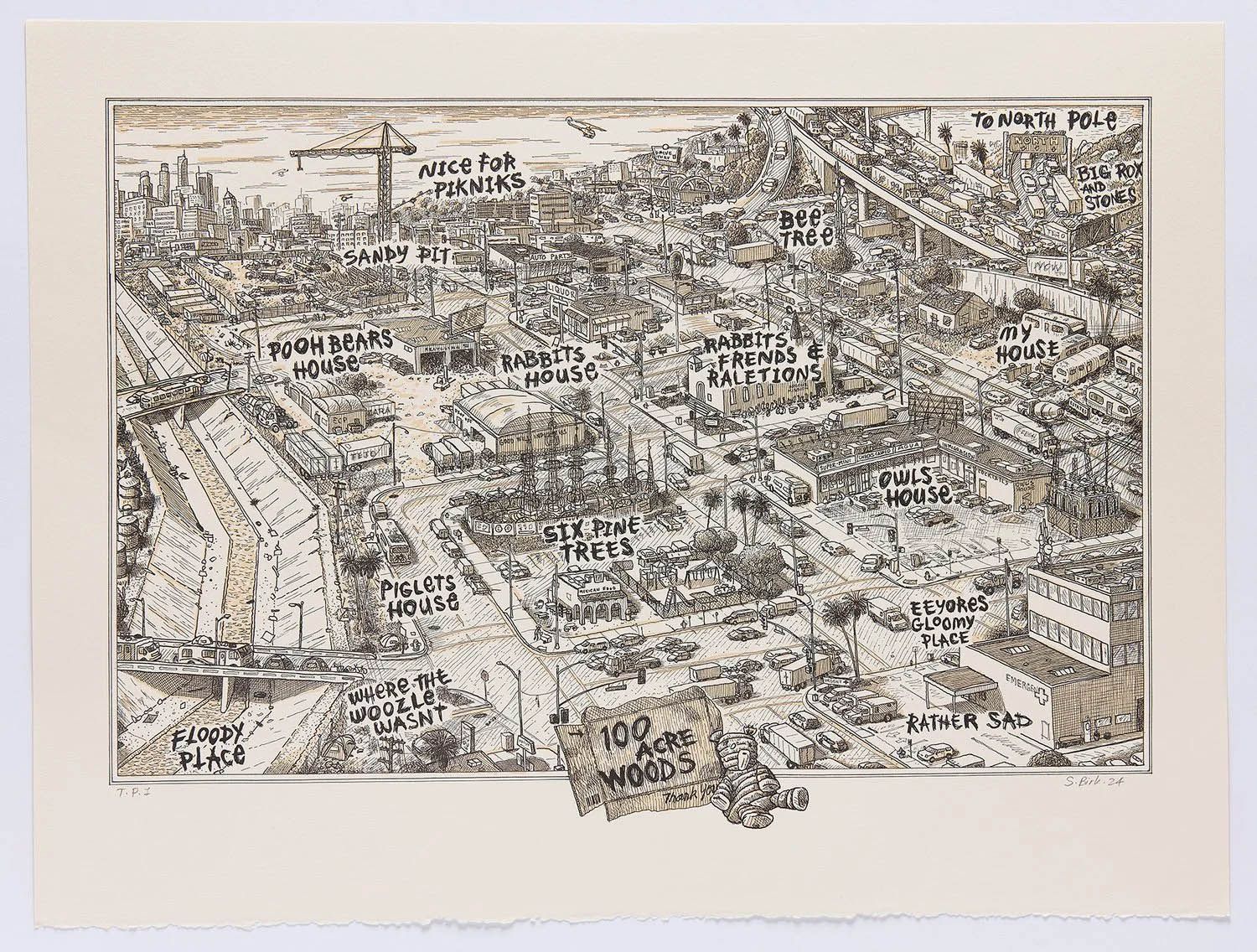
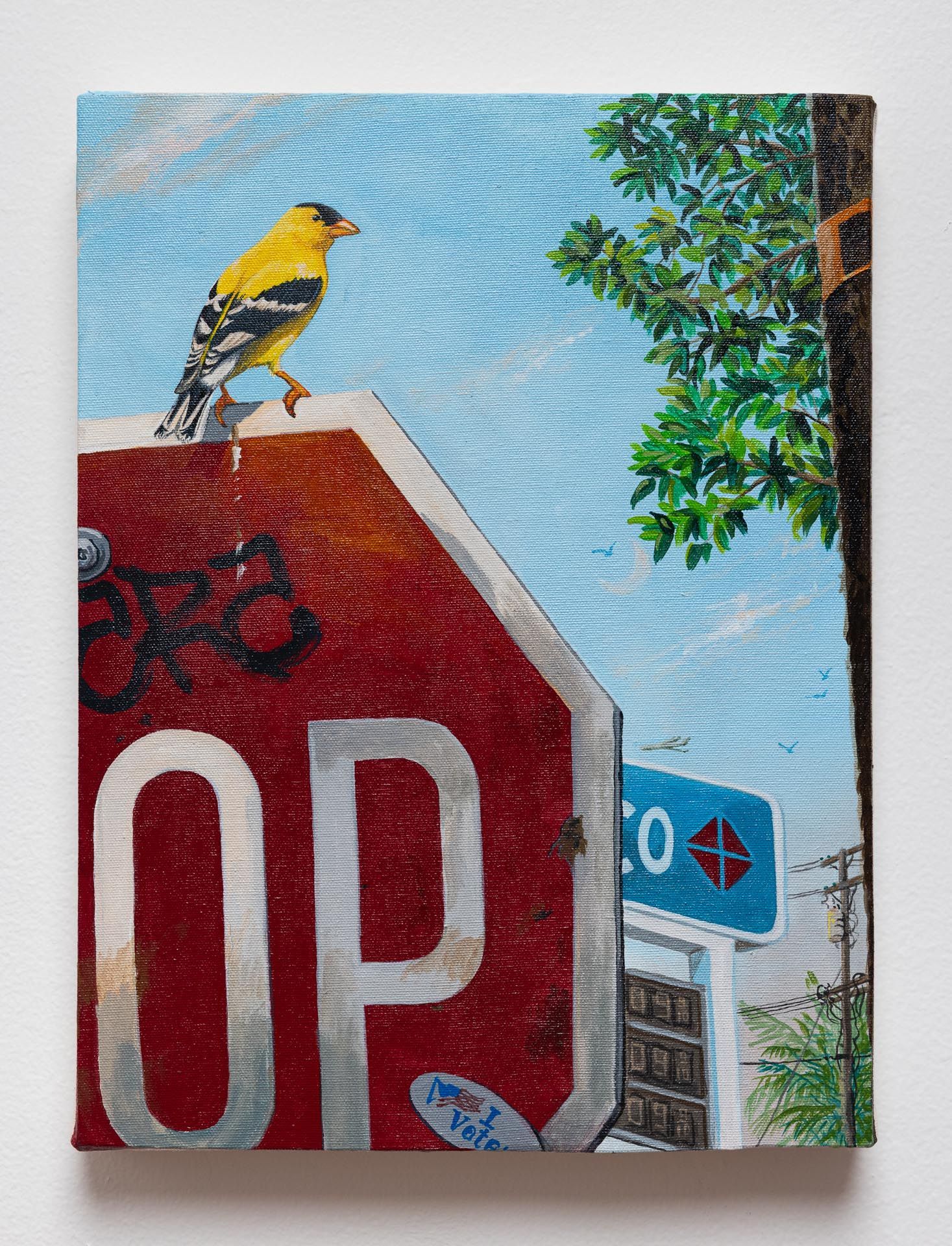
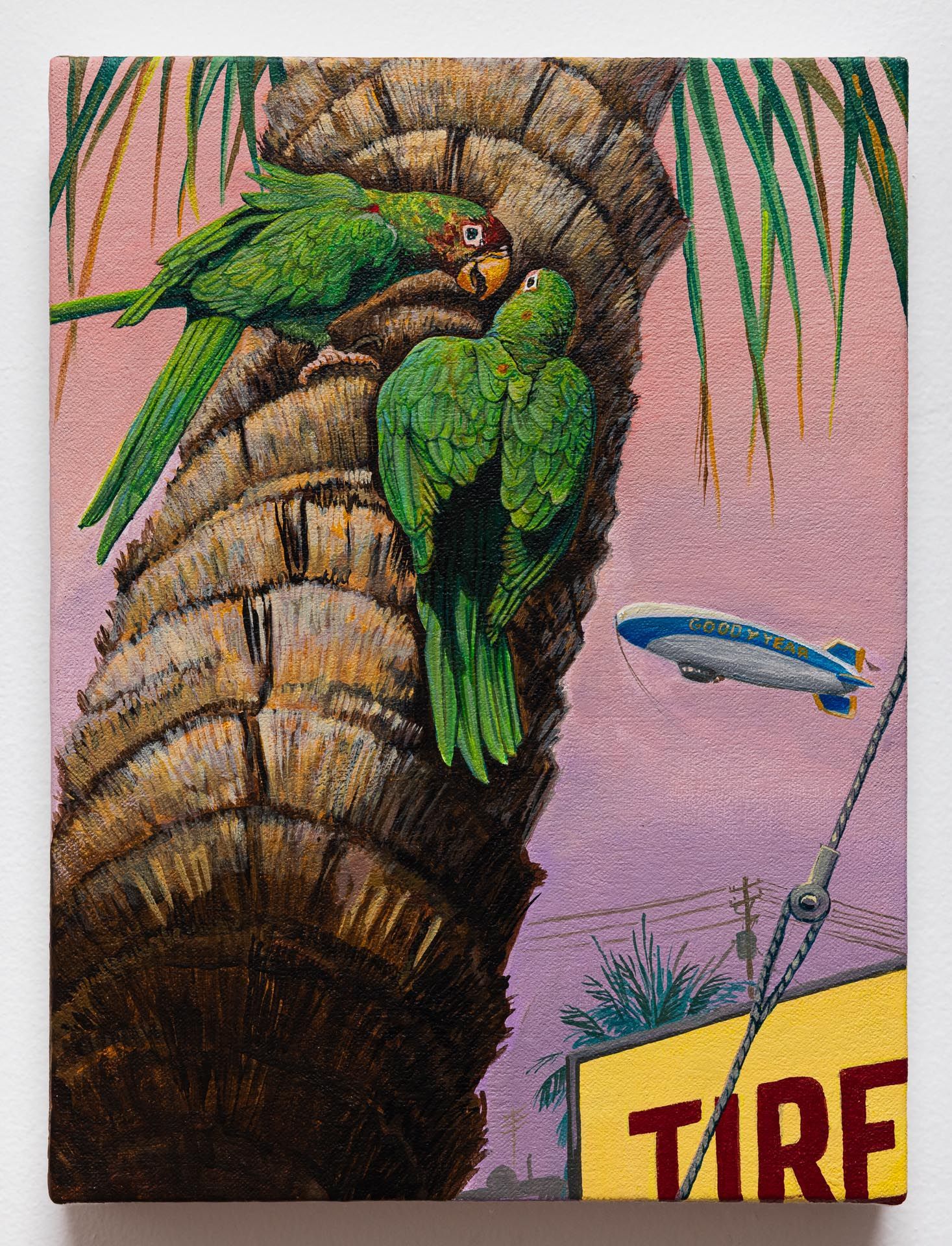
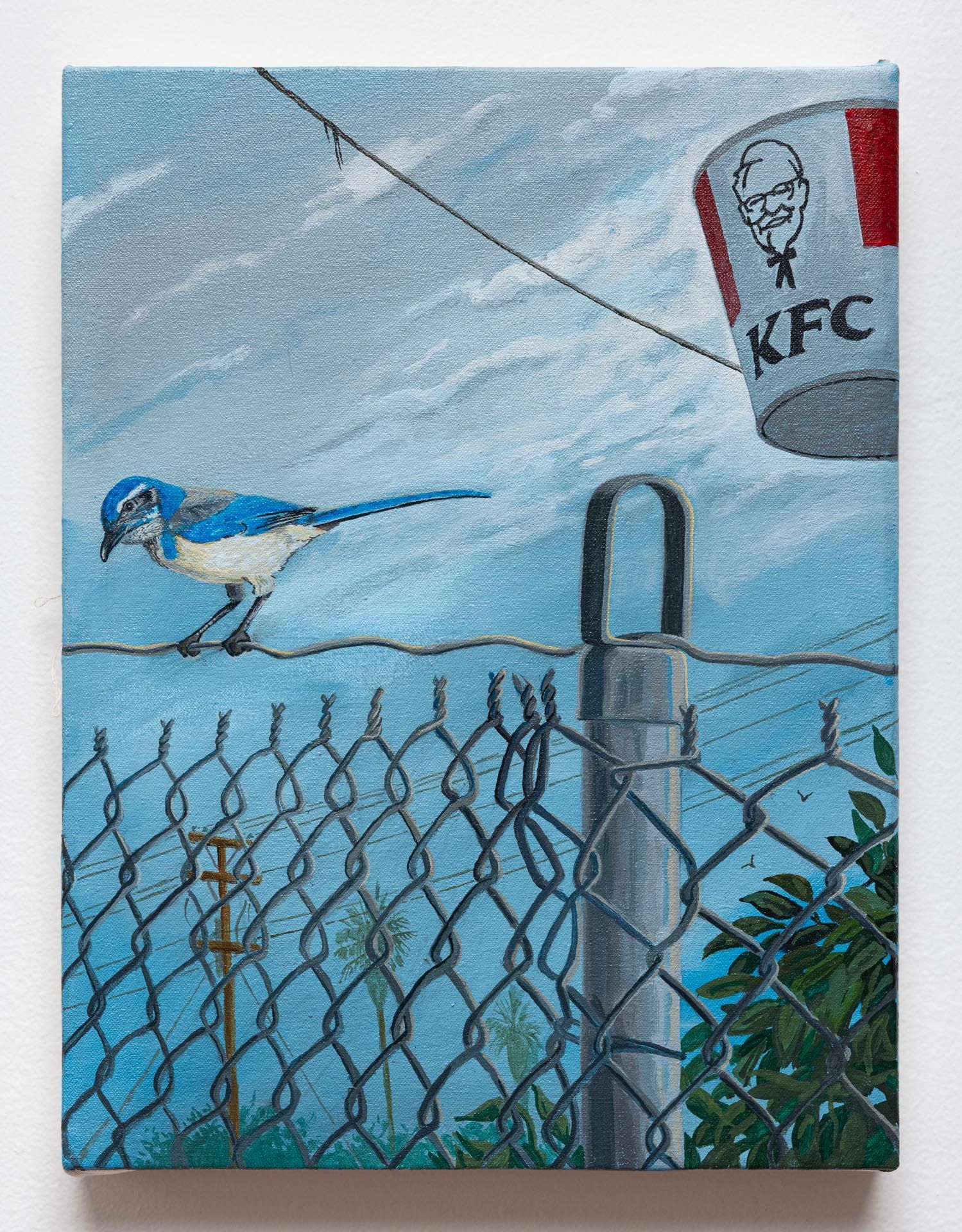
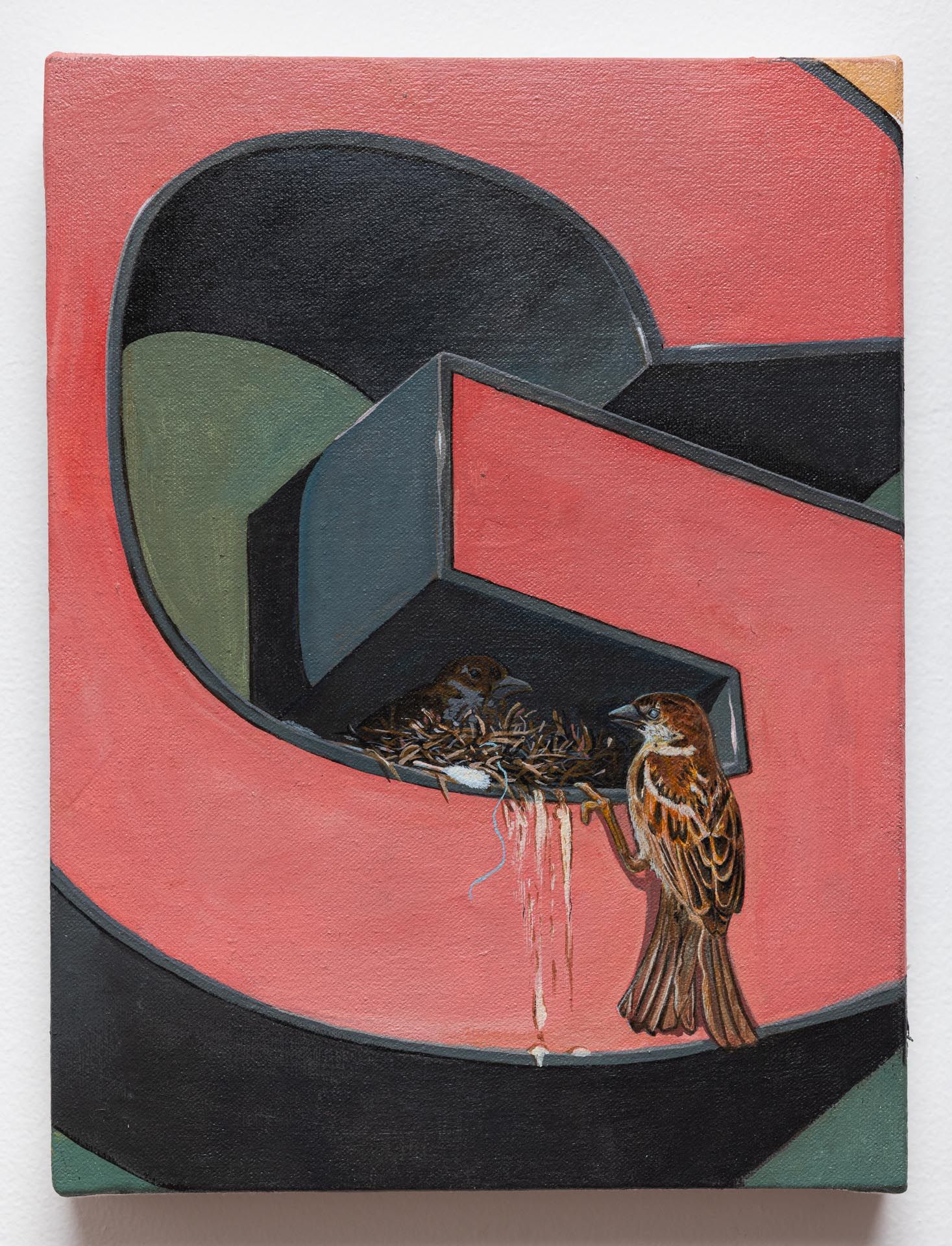
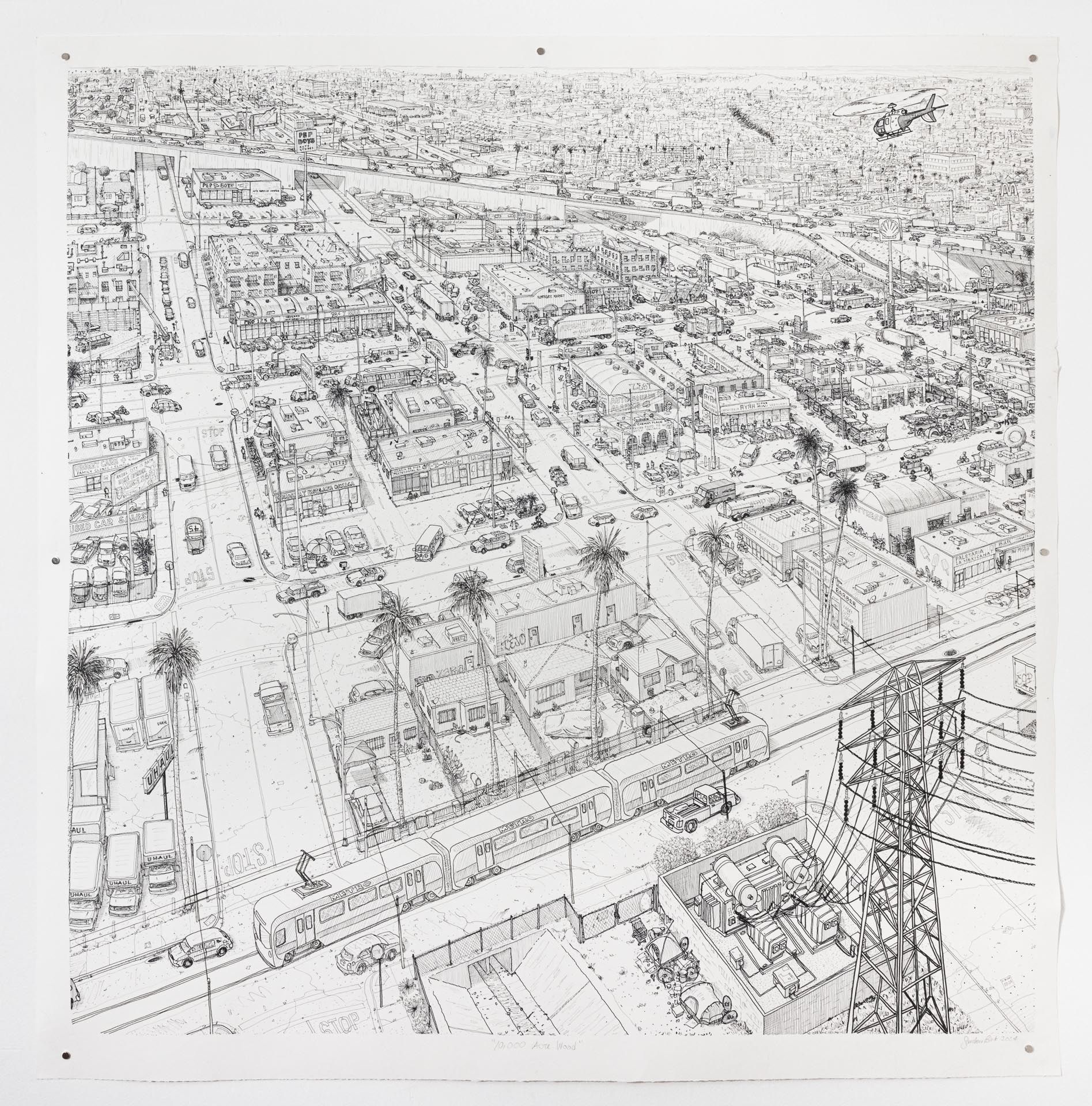
The narrative continues into our own city. In Birk’s reimagining of The House at Pooh Corner, an elderly, unhoused Christopher Robin wanders Los Angeles, the “100 Acre Wood” transformed into an urban terrain where memory and present reality collapse into one another. Additionally, a new series of small paintings of common urban birds perch among power lines and street signs, examining the quiet witnesses to a landscape shaped as much by human intervention as by nature.
Across
Snafu, these narratives accumulate into a question: in a world we continue to build, revise, and inhabit, how can we escape the treachery of inhuman intervention and the frightening outcomes we must live with?
ABOUT THE ARTIST
Los Angeles artist Sandow Birk is a graduate of the Otis/Parson's Art Institute whose work deals with contemporary life. Frequently developed as expansive, multi-media projects, past themes have included inner-city violence, graffiti, social and political issues, travel, prisons, Islam, surfing, and skateboarding. He was a recipient of an NEA International Travel Grant to Mexico City in 1995, a Guggenheim Fellowship in 1996, and a Fulbright Fellowship to Rio de Janeiro for 1997. In 1999, he was awarded a Getty Fellowship for painting, a City of Los Angeles (COLA) Fellowship in 2001. Most recently, he was awarded a Gottlieb Foundation Fellowship for his career of work. One of his projects involved the rewriting and illustrating of the entire
Divine Comedy into contemporary American English. A feature film of the project,
Dante’s Inferno, was released in 2007. He was awarded an Artist Research Fellowship at the Smithsonian Institution in Washington, D.C. in 2007, and he was an Artist in Residence at the Cite Internationale des Arts in Paris in 2008, and at the Ballinglen Arts Foundation in Ireland in 2011. In 2014, he was named as a United States Artist Knight Fellow. His recently published mega-project
American Qur’an, is an illuminated manuscript of the entire Koran in English, in consideration of its relevance to contemporary life in America. His most recent works,
Imaginary Monuments, consider important documents in world history. Currently, Birk is finalizing a 150-foot, glass-mosaic mural project for the future Westwood/VA Hospital Station on LA Metro’s D Line, which is expected to open before the 2028 Summer Olympics in Los Angeles.